

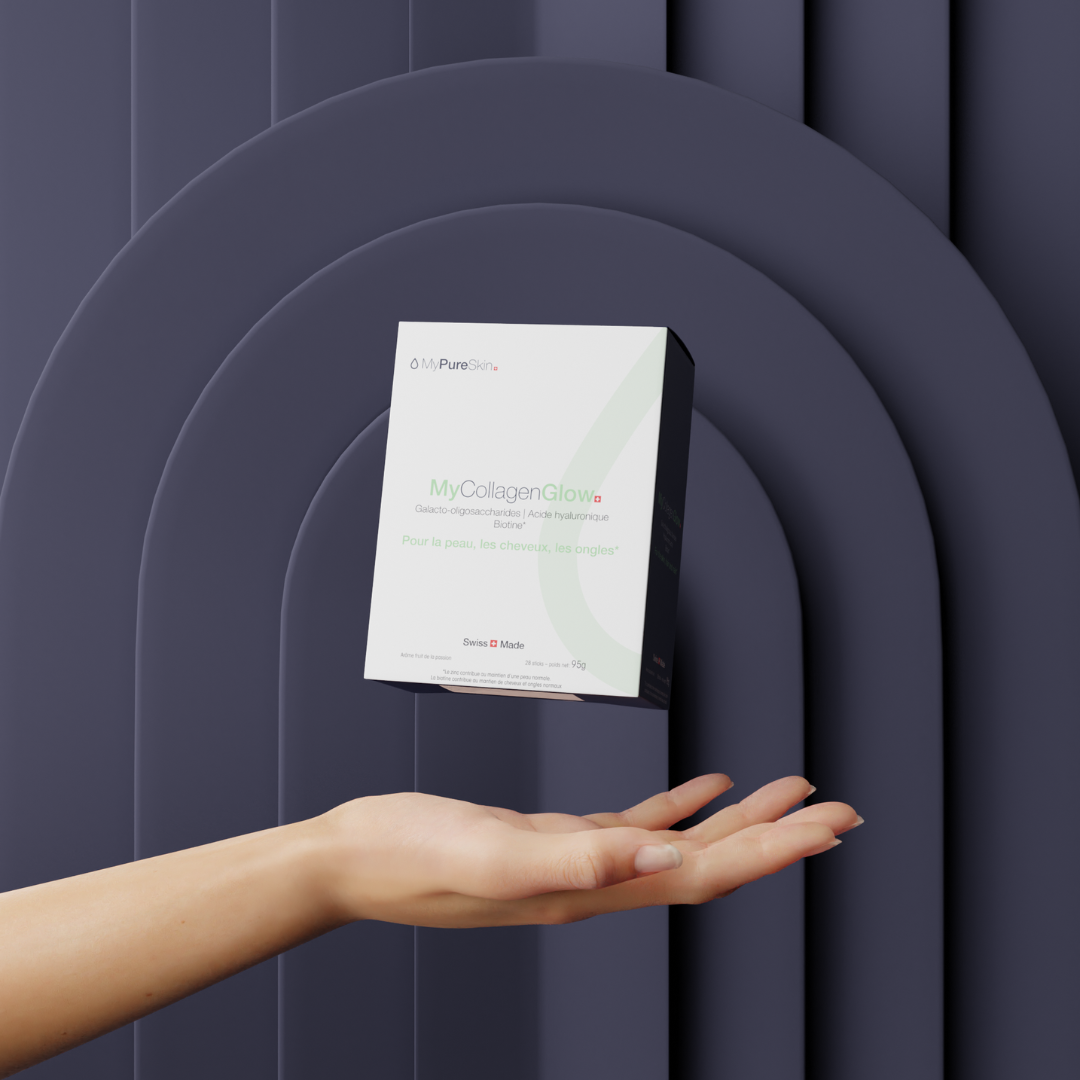
MyCollagenGlow – Schönheit, die von innen strahlt
MyCollagenGlow ist ein Nutrikosmetikum der neuen Generation, das von innen auf die Grundpfeiler der Hautschönheit wirkt.
Die Formulierung vereint Präbiotika (GOS), Hyaluronsäure, Biotin, Vitamine und Antioxidantien, um die Strahlkraft des Teints, die Hautfeuchtigkeit, die Vitalität von Haaren und Nägeln sowie das Gleichgewicht des Hautmikrobioms zu unterstützen.
Natürliche Expertise
Wirkungsstarke Inhaltsstoffe, die Haut, Haare und Nägel von innen heraus zum Strahlen bringen.
Klinisch belegte Wirkstoffe, die tief in die Haut eindringen
| Inhaltsstoff | Beschreibung | Klinische Studie |
|---|---|---|
| Meereskollagenpeptide | Die Einnahme von Kollagen in Form von Nutrikosmetika kann dazu beitragen, die Haut gesund zu erhalten, Haarausfall und Haarausdünnung vorzubeugen sowie brüchige Nägel zu stärken. |
Reilly DM, Lozano J. Skin collagen through the lifestages: importance for skin health and beauty. Plast Aesthet Res 2021;8:2.http://dx.doi.org/10.20517/2347-9264.2020.153. |
| Hyaluronsäure | Die Wirkung oraler Hyaluronsäure wird seit Jahren intensiv erforscht. Sie zielt auf dermale Fibroblasten ab, die Hyaluronsäure in der Dermis synthetisieren. Dadurch wird die Hautfeuchtigkeit gefördert und sichtbare Zeichen der Hautalterung werden verbessert. |
Papakonstantinou E, Roth M, Karakiulakis G. Hyaluronic acid: A key molecule in skin aging. Dermatoendocrinol. 2012;4(3):253-258. |
| Galactooligosaccharide (GOS) | Galactooligosaccharide (GOS) verbessern die Hautgesundheit über das Darmmikrobiom. Sie fördern die Feuchtigkeitsversorgung, stärken die Hautbarriere, reduzieren Entzündungen und schützen vor UV-Strahlung. Diese Wirkweise fügt sich in den neuen Ansatz der Darm-Haut-Achse ein und ebnet den Weg für innovative Ernährungsstrategien in der Hautpflege. |
Hong YH, Chang UJ, Kim YS, Jung EY, Suh HJ. Dietary galacto-oligosaccharides improve skin health: a randomized double blind clinicaltrial. Asia Pac J Clin Nutr. 2017;26(4):613-618. doi: 10.6133/apjcn.052016.05. PMID: 28582809https://pubmed.ncbi.nlm.nih.gov/28582809/ |
| Acerola-Extrakt – Vitamin C | Zahlreiche wissenschaftliche Studien belegen die positive Wirkung von Vitamin C auf die Haut. Die orale Einnahme hilft, Hautoxidation entgegenzuwirken, fördert das Zellwachstum und die Zelldifferenzierung und trägt zur Zellerneuerung bei. Darüber hinaus kann Vitamin C die Kollagenproduktion in der Dermis anregen und so die Festigkeit und Elastizität der Haut verbessern. |
Pullar J.M., Carr A.C., Vissers M.C.M. The roles of vitamin C in skin health. Nutrients. 2017; 9:866–892.https://www.ncbi.nlm.nih.gov/pmc/articles/PMC5579659/ |
| Vitamin E | Vitamin E ist ein wichtiger Bestandteil der antioxidativen Hautabwehr und bietet besonderen Schutz vor UV-Strahlung und freien Radikalen. Durch die orale Einnahme von Vitamin E kann der Lichtschutz der Haut wirksam verbessert werden. Darüber hinaus wirkt Vitamin E entzündungshemmend, indem es als Radikalfänger und Modulator von Entzündungssignalen agiert. |
Maalouf S, El-Sabban M, Darwiche N, Gali-Muhtasib H. Protective effect of vitamin E on ultraviolet B light-induced damage inkeratinocytes. Mol Carcinog. 2002;34:121–30. https://pubmed.ncbi.nlm.nih.gov/12112306/ |
| Vitamin B5 | Vitamin B5 ist essenziell für die Energieproduktion und fördert die Gesundheit von Haut und Haaren. Es verbessert die Barrierefunktion der Epidermis, reguliert Entzündungen und hat sich bei der Reduktion von Akne und Hautunreinheiten als wirksam erwiesen. |
Capodice JL. Feasibility, tolerability, safety and efficacy of a pantothenic acid based dietary supplement in subjects with mild tomoderate facial acne blemishes. J Cosmet Dermatol Sci Appl. 2012;2:132–5. https://www.scirp.org/html/22372.html |
| Vitamin B6 | Vitamin B6 spielt eine Schlüsselrolle im Proteinstoffwechsel sowie bei der Zellregeneration. Es trägt zur Hautgesundheit bei, beugt bestimmten Formen von Dermatitis vor und kann Haarausfall reduzieren. |
Kato, Norihisa. (2012). Role of vitamin B6 in skin health and diseases. 10.3920/978-90-8686-729-5_4. |
| Vitamin B12 | Vitamin B12 hat einen Einfluss auf die Gesundheit von Haut, Haaren und Nägeln. Ein Mangel oder Überschuss kann zu Hauterkrankungen wie Hyperpigmentierung, Ekzemen oder Akne führen. Zudem fördert Vitamin B12 das Haarwachstum, indem es die Mikrozirkulation und Sauerstoffversorgung der Haarfollikel verbessert. |
Brescoll J, Daveluy S. A review of vitamin B12 in dermatology. Am J Clin Dermatol. 2015 Feb;16(1):27-33. doi: 10.1007/s40257-014-
0107-3. PMID: 25559140.
|
| Zink | Verschiedene Studien belegen einen Zusammenhang zwischen einem niedrigen Zinkspiegel und bestimmten Formen von Haarausfall wie Telogeneffluvium und Alopecia areata. Eine orale Zinksupplementierung kann Haarausfall lindern, indem sie festgestellte Mängel ausgleicht. |
Gupta M, Mahajan VK, Mehta KS, Chauhan PS. Zinc therapy in dermatology: a review. Dermatol Res Pract. 2014;2014:709152. doi:
10.1155/2014/709152. Epub 2014 Jul 10. PMID: 25120566; PMCID: PMC4120804. https://pubmed.ncbi.nlm.nih.gov/25120566/
|
| Vitamin B8 (Biotin) | Biotin spielt eine Schlüsselrolle bei der Keratinsynthese sowie dem Erhalt der Struktur von Haaren und Nägeln. Es fördert das Wachstum der Haarfollikel und stärkt die Nägel. Eine Supplementierung kann helfen, dünnes Haar, brüchige Nägel und mangelbedingten Haarausfall zu verbessern. |
Chessa MA, Iorizzo M, Richert B, López-Estebaranz JL, Rigopoulos D, Tosti A, Gupta AK, Di Chiacchio N, Di Chiacchio NG, Rubin AI,
Baran R, Lipner SR, Daniel R, Chiheb S, Grover C, Starace M, Piraccini BM. Pathogenesis, Clinical Signs and Treatment Recommendations
in Brittle Nails: A Review. Dermatol Ther (Heidelb). 2020 Feb;10(1):15-27. doi: 10.1007/s13555-019-00338-x. Epub 2019 Nov 20. Erratum
in: Dermatol Ther (Heidelb). 2020 Jan 22;: PMID: 31749091; PMCID: PMC6994568
https://www.ncbi.nlm.nih.gov/pmc/articles/PMC6994568/
|
| Beta-Carotin | Carotinoide, insbesondere Beta-Carotin, wurden intensiv auf ihre positiven Auswirkungen auf die Haut untersucht. Sie schützen nachweislich vor den schädlichen Auswirkungen der Sonneneinstrahlung wie Sonnenbrand und Lichtalterung. |
Baswan SM, Klosner AE, Weir C, Salter-Venzon D, Gellenbeck KW, Leverett J, Krutmann J. Role of ingestible carotenoids in skin
protection: A review of clinical evidence. Photodermatol Photoimmunol Photomed. 2021 Nov;37(6):490-504. doi: 10.1111/phpp.12690.
Epub 2021 May 20. PMID: 33955073.
|
Reilly DM, Lozano J. Skin collagen through the lifestages: importance for skin health and beauty. Plast Aesthet Res 2021;8:2.http://dx.doi.org/10.20517/2347-9264.2020.153.
Choi, F.D.; Sung, C.T.; Juhasz, M.L.; Mesinkovsk, N.A. Oral Collagen Supplementation: A Systematic Review of DermatologicalApplications. J. Drugs. Dermatol. 2019, 18, 9–16. https://pubmed.ncbi.nlm.nih.gov/30681787/
Al-Atif H. Collagen Supplements for Aging and Wrinkles: A Paradigm Shift in the Fields of Dermatology and Cosmetics. Dermatol PractConcept. 2022 Jan 1;12(1):e2022018. doi: 10.5826/dpc.1201a18. PMID: 35223163; PMCID: PMC8824545.https://www.ncbi.nlm.nih.gov/pmc/articles/PMC8824545/
Ito, M., Sato, Y. Dynamic ultrastructural changes of the connective tissue sheath of human hair follicles during hair cycle. ArchDermatol Res 282, 434–441 (1990). https://doi.org/10.1007/BF00402618
Papakonstantinou E, Roth M, Karakiulakis G. Hyaluronic acid: A key molecule in skin aging. Dermatoendocrinol. 2012;4(3):253-258.
doi:10.4161/derm.21923
Meyer LJ, Stern R. Age-dependent changes of hyaluronan in human skin. J Invest Dermatol 1994; 102:385- 9; PMID:8120424;
http://dx.doi.org/10.1111/1523- 1747.ep12371800
Hong YH, Chang UJ, Kim YS, Jung EY, Suh HJ. Dietary galacto-oligosaccharides improve skin health: a randomized double blind clinicaltrial. Asia Pac J Clin Nutr. 2017;26(4):613-618. doi: 10.6133/apjcn.052016.05. PMID: 28582809https://pubmed.ncbi.nlm.nih.gov/28582809/
Suh, Min Geun et al. “Inhibitory Effect of Galactooligosaccharide on Skin Pigmentation.” Preventive nutrition and food science vol.24,3 (2019): 321-326. Sci. 2020;21:741. https://pubmed.ncbi.nlm.nih.gov/31608258/
Pullar J.M., Carr A.C., Vissers M.C.M. The roles of vitamin C in skin health. Nutrients. 2017; 9:866–892.https://www.ncbi.nlm.nih.gov/pmc/articles/PMC5579659/
Maalouf S, El-Sabban M, Darwiche N, Gali-Muhtasib H. Protective effect of vitamin E on ultraviolet B light-induced damage inkeratinocytes. Mol Carcinog. 2002;34:121–30. https://pubmed.ncbi.nlm.nih.gov/12112306/
Musalmah M, Fairuz AH, Gapor MT, Ngah WZ. Effect of vitamin E on plasma malondialdehyde, antioxidant enzyme levels and the ratesof wound closures during wound healing in normal and diabetic rats. Asia Pac J Clin Nutr. 2002;11 Suppl 7:S448-451. (PubMed)
Capodice JL. Feasibility, tolerability, safety and efficacy of a pantothenic acid based dietary supplement in subjects with mild tomoderate facial acne blemishes. J Cosmet Dermatol Sci Appl. 2012;2:132–5. https://www.scirp.org/html/22372.html
Kato, Norihisa. (2012). Role of vitamin B6 in skin health and diseases. 10.3920/978-90-8686-729-5_4.
Brescoll J, Daveluy S. A review of vitamin B12 in dermatology. Am J Clin Dermatol. 2015 Feb;16(1):27-33. doi: 10.1007/s40257-014-
0107-3. PMID: 25559140.
Almohanna HM, Ahmed AA, Tsatalis JP, Tosti A. The Role of Vitamins and Minerals in Hair Loss: A Review. Dermatol Ther (Heidelb).
2019;9(1):51-70. doi:10.1007/s13555-018-0278-6 https://www.ncbi.nlm.nih.gov/pmc/articles/PMC6380979/
Gupta M, Mahajan VK, Mehta KS, Chauhan PS. Zinc therapy in dermatology: a review. Dermatol Res Pract. 2014;2014:709152. doi:
10.1155/2014/709152. Epub 2014 Jul 10. PMID: 25120566; PMCID: PMC4120804. https://pubmed.ncbi.nlm.nih.gov/25120566/
Ogawa Y, Kinoshita M, Shimada S, Kawamura T. Zinc and Skin Disorders. Nutrients. 2018 Feb 11;10(2):199. doi: 10.3390/nu10020199.
PMID: 29439479; PMCID: PMC5852775. https://pubmed.ncbi.nlm.nih.gov/29439479/
Chessa MA, Iorizzo M, Richert B, López-Estebaranz JL, Rigopoulos D, Tosti A, Gupta AK, Di Chiacchio N, Di Chiacchio NG, Rubin AI,
Baran R, Lipner SR, Daniel R, Chiheb S, Grover C, Starace M, Piraccini BM. Pathogenesis, Clinical Signs and Treatment Recommendations
in Brittle Nails: A Review. Dermatol Ther (Heidelb). 2020 Feb;10(1):15-27. doi: 10.1007/s13555-019-00338-x. Epub 2019 Nov 20. Erratum
in: Dermatol Ther (Heidelb). 2020 Jan 22;: PMID: 31749091; PMCID: PMC6994568
https://www.ncbi.nlm.nih.gov/pmc/articles/PMC6994568/
Patel DP, Swink SM, Castelo-Soccio L. A Review of the Use of Biotin for Hair Loss. Skin Appendage Disord. 2017 Aug;3(3):166-169.
doi: 10.1159/000462981. Epub 2017 Apr 27. PMID: 28879195; PMCID: PMC5582478. https://pubmed.ncbi.nlm.nih.gov/28879195/
Baswan SM, Klosner AE, Weir C, Salter-Venzon D, Gellenbeck KW, Leverett J, Krutmann J. Role of ingestible carotenoids in skin
protection: A review of clinical evidence. Photodermatol Photoimmunol Photomed. 2021 Nov;37(6):490-504. doi: 10.1111/phpp.12690.
Epub 2021 May 20. PMID: 33955073.
Panich U, Sittithumcharee G, Rathviboon N, Jirawatnotai S. Ultraviolet radiation-induced skin aging: the role of DNA damage and
oxidative stress in epidermal stem cell damage mediated skin
aging. Stem Cells Int. 2016;2016:7370642.